


Save over 1,300 euros per year? Try the 52-week strategy.
Need to save money for a larger margin in your monthly family budget, or for a future project? There are various strategies you can use, such as the 52-week challenge. Have you heard of it? Find out how it works next.
17 abr 2026 • 4 min


If you have credits and insurance, you can also try to review the contract conditions with the contracting entities. Contact Poupança no Minuto and, with the free help of a credit intermediary, find out which options are right for you. But first, understand what the 52-week strategy is and how to apply it.
How to apply the 52-week savings strategy?
Want to start the year putting some money aside, without noticing the impact on your wallet? The 52-week strategy is ideal for this goal: it helps you save a certain amount each week of the year, which increases and, annually, ends up becoming a significant amount. So, if you are looking to start saving for a future project, pay off debts, or for a larger budgetary cushion, take note of the procedure of this strategy.
This challenge involves little difficulty, which, however, increases over the months of the year. This is because the amount you set aside increases from week to week. It can be a good habit to gain to achieve financial discipline.
The strategy did not need to be followed exactly. As long as part of the monthly income is set aside, progressively, weekly from January to December, the challenge of the 52 weeks is applied. This is the number of weeks in a year.
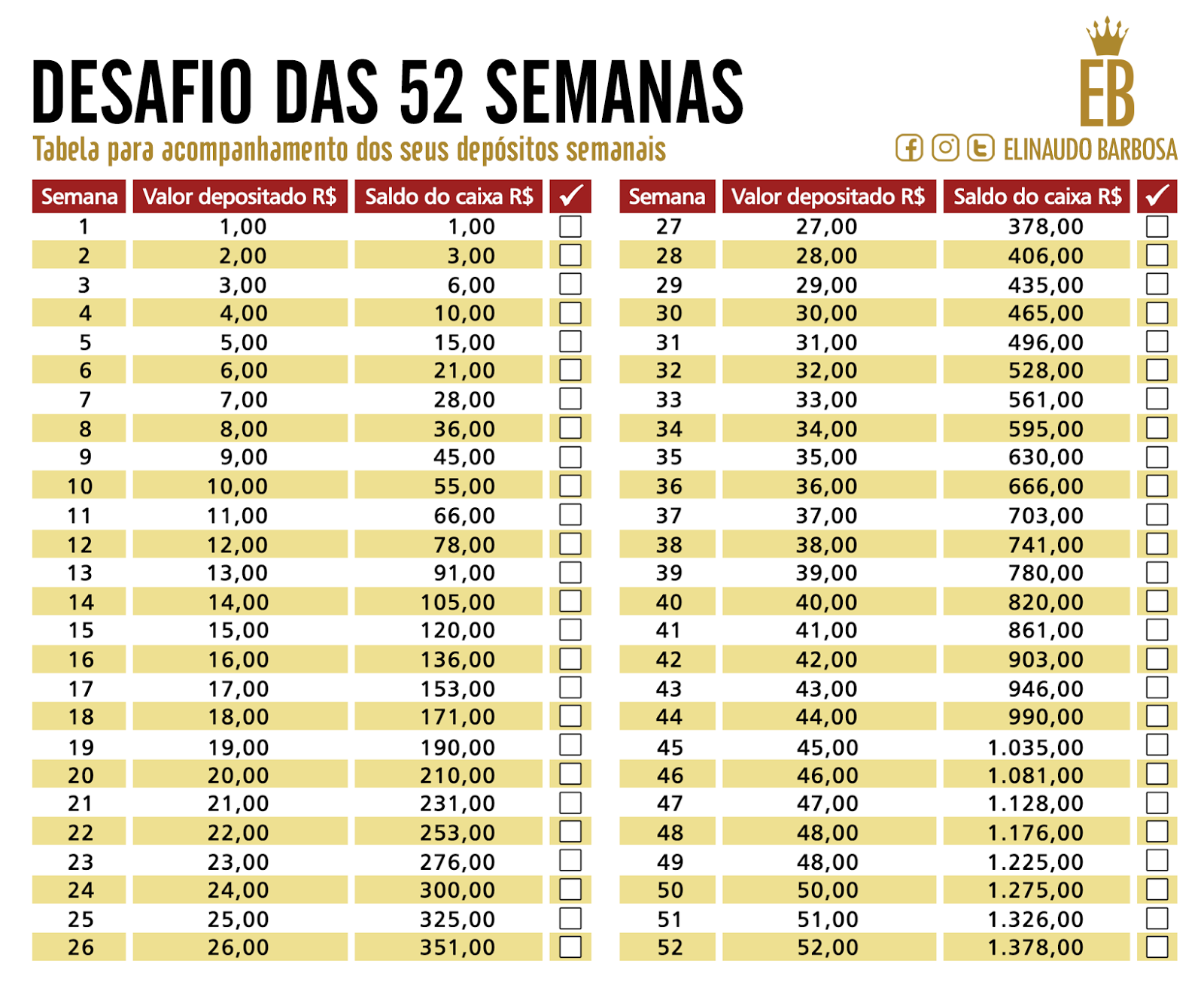
As a rule, you withdraw 1 euro in January, 2 euros in February, 3 euros in March, and so on. If you follow this challenge with this strategy, you will end the year saving an exact accumulated value of 1,378 euros.
If you notice, it's not a very complicated strategy to follow, because the maximum you have to set aside is 52 euros in the last week of the year. Therefore, it is not a challenging amount, but it allows you to save an impactful amount at the end of a full year.
What challenges might I encounter?
The biggest challenge you may encounter is remembering to put aside the stipulated amount for that period weekly, which will require attention and dedication on your part. For this, you can set a reminder on your phone, so you don't forget. To make it easier, you can even add up the weekly amounts for the month and save monthly.
That is, in the first 4 weeks the amount to set aside will be: 1st week – 1 euro, 2nd week – 2 euros, 3rd week – 3 euros, and 4th week – 4 euros, which will total €10 in the first month.
Another issue that may arise is where to put the saved money: it should be a safe place and more difficult to access, in order not to have the temptation to withdraw the money before the time. Some ideas may include simply putting it in a savings account or in another separate bank account, then you can invest by putting the amount in a retirement savings plan (PPR), or in savings certificates, or (in the old-fashioned way) withdraw the money and put it in a safe, piggy bank or even under the mattress.
To be able to find and set aside this savings, you can choose to revisit contracts you have for credits and/or insurances. Count on the free help of "Poupança no Minuto": we offer proposals with more advantageous conditions than your current ones. Use and abuse our simulators and see how much you can save!
Did you enjoy reading? Share it!
Related Articles
Mortgage brokers - What are they and why use these services?

7 min
What should you do before buying a house?
3 min
FINE: Learn how to analyze a credit proposal
5 min
Effort rate: What is this concept and how is it calculated?
9 min
Want to save on credits and insurance?
Subscribe to our newsletter and never miss any content. Learn how to have a healthier financial life.




Talk to an agent now
Want to know more? Talk to one of our agents to clarify any doubts and discover the perfect solution for you.
Call to national landline | Monday to Friday, 9am to 7pm.